Estimate smart-lighting electricity without promising savings
Use your own watts, hours and tariff, then keep standby and hub consumption separate from the active-use calculation.
Updated:
Begin with a clearly bounded calculation
An electricity estimate needs input power, operating time and your unit rate. It does not follow directly from the word smart or from a bulb's maximum light output. Philips Hue's brightness guide distinguishes watts, which describe input power, from lumens, which describe light output. Use a suitable power figure for the operating condition you are modelling.
Write the boundary before entering numbers: active lighting only, for a stated number of lamps and hours. This prevents the result being mistaken for the whole smart-home cost. If a power figure represents a maximum rather than measured average use, label that assumption. A precise-looking decimal does not remove uncertainty in the inputs.
Philips Hue UK: lumens and smart bulb brightness ?
Work through the annual example
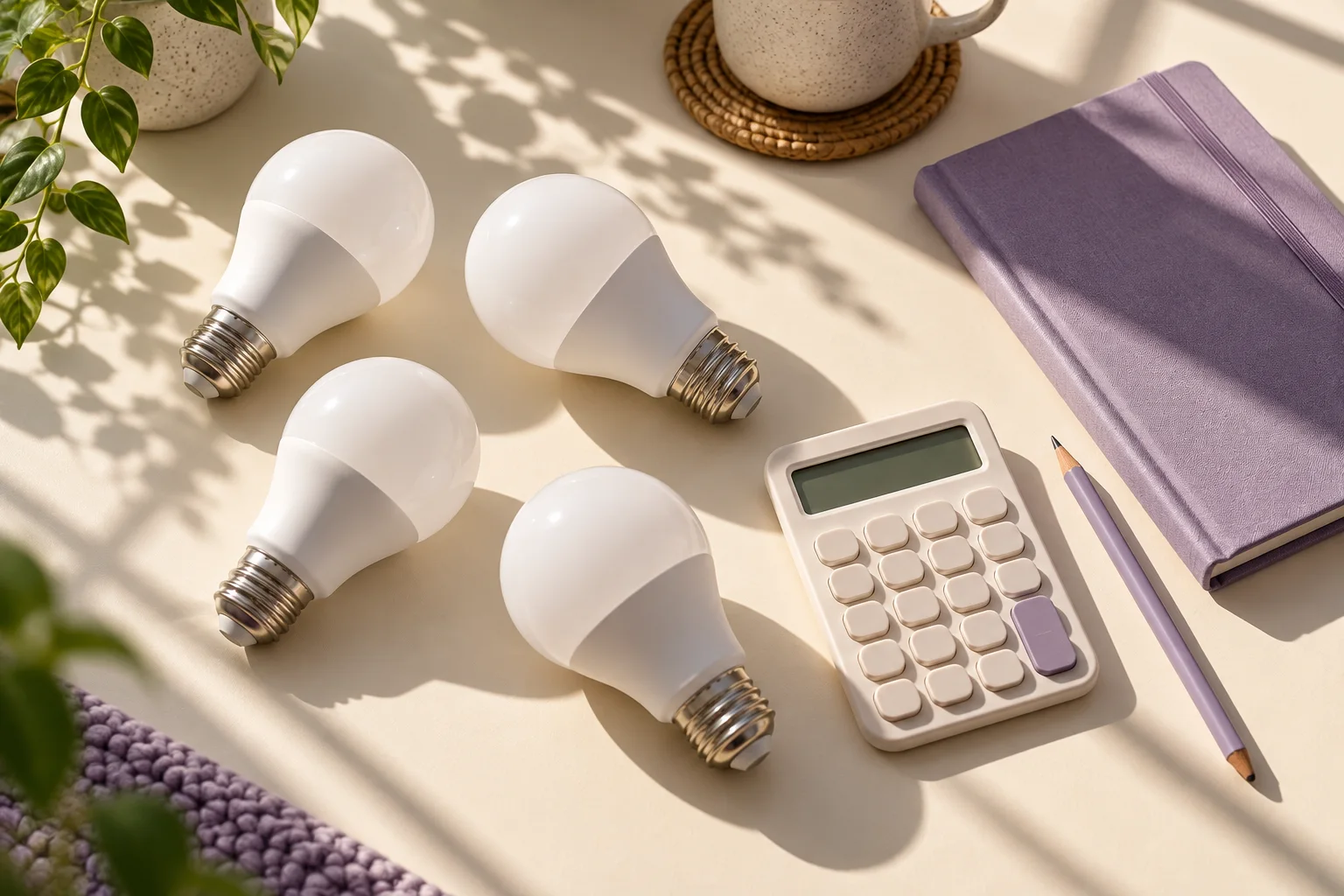
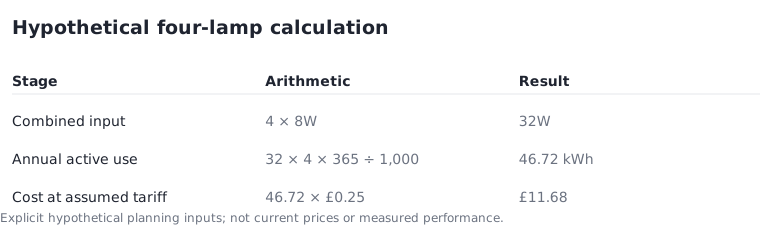
Assume four lamps each use 8 watts for four hours per day, on 365 days. The combined assumed power is 32 watts. Multiplying by the hours and days gives 46,720 watt-hours, which is 46.72 kWh. At an assumed tariff of 25 pence per kWh, the final active-use electricity cost is £11.68 for the year.
Every input here is a planning assumption, not a current tariff or measured product test. The result excludes standing charges, hubs and standby consumption. If you enter your own figures in the calculator, keep the same units: watts for each lamp, hours per day, days per year and pence per kWh. Entering pounds in the pence field changes the answer incorrectly.
Keep an automation scenario separate
A routine can change operating time, but its actual effect depends on how people use the lights. A motion-triggered setting may avoid some unwanted use or may turn lights on in circumstances where they previously stayed off. The manufacturer's motion-sensor guidance describes configurable daylight and timing behaviour; it does not establish a universal household saving.
For a hypothetical comparison only, reduce the four-lamp example from four hours to three hours per day. The assumed energy becomes 35.04 kWh and the cost £8.76 at the same tariff. The difference is £2.92 per year. That is the arithmetic consequence of one assumed hour less, not a forecast that adding a sensor will achieve it.
Philips Hue UK: indoor motion sensor requirements and operation ?
Add other consumption only with valid inputs
If you want a broader estimate, create a separate line for each additional component and its relevant power and time assumptions. Do not enter a hub's maximum adapter rating as if it were measured constant consumption. If the necessary consumption information is unavailable, leave that line explicitly unresolved rather than filling it with an attractive small number.
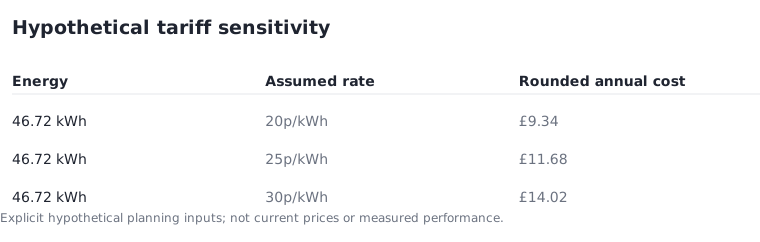
You can still compare tariff sensitivity for the known lighting example. At assumed rates of 20, 25 and 30 pence per kWh, 46.72 kWh costs £9.34, £11.68 and £14.02 respectively after rounding. These are hypothetical unit-rate scenarios, not current regulated tariffs or a prediction of future prices.
Use the result to inform a modest decision
Save the inputs and exclusions with the result so you can update the estimate when your use changes. A useful record includes the number of lamps, input-power basis, daily hours, annual days and tariff date. If you later measure actual use, label that new evidence separately from the original planning scenario.
Use convenience and lighting suitability as explicit reasons for buying automation when those are the real benefits you want. Do not force a small or uncertain energy estimate into a savings claim. The calculator can show what follows from your assumptions; it cannot prove that the behaviour will happen or that the full system will pay for itself.
Philips Hue UK: lumens and smart bulb brightness ?